
Monsoon Season and Your AV Equipment: What Actually Protects It
Southern Arizona monsoon takes out more home electronics than anything else we see. Grounding, surge protection and the failures that are avoidable.
- Monsoon
- Service
- Tucson
Every year from roughly late June through September, our service calls change character. Monsoon takes out more home electronics in Southern Arizona than any other single cause, and a meaningful share of that damage is avoidable.
How the damage actually arrives
People picture a direct lightning strike. Direct strikes happen, and nothing survives them, but they are rare. The far more common failure is an induced surge: lightning hits somewhere in the neighborhood, the electrical or cable infrastructure carries a voltage spike, and that spike arrives at your equipment through the power outlet, the coax, the incoming internet line, or a long run of speaker or network cable acting as an antenna.
That last route is the one people miss. A power strip on the receiver does nothing if the surge comes in on the coax from a roof antenna or a long outdoor speaker run.
What actually protects equipment
Proper grounding first
Surge protection works by diverting energy to ground. If the ground path is poor, the protector cannot do its job regardless of its joule rating. This is why we care about the electrical side of the install — we are a licensed residential and commercial electrical contractor under ROC 349867 & ROC 364786, so verifying and correcting grounding is work we do ourselves rather than subcontract.
Whole-home protection at the panel
A service-entrance surge protective device clamps the largest events before they reach anything. It is the highest-value single item in this article and typically the cheapest per dollar of equipment protected.
Point-of-use protection at the rack
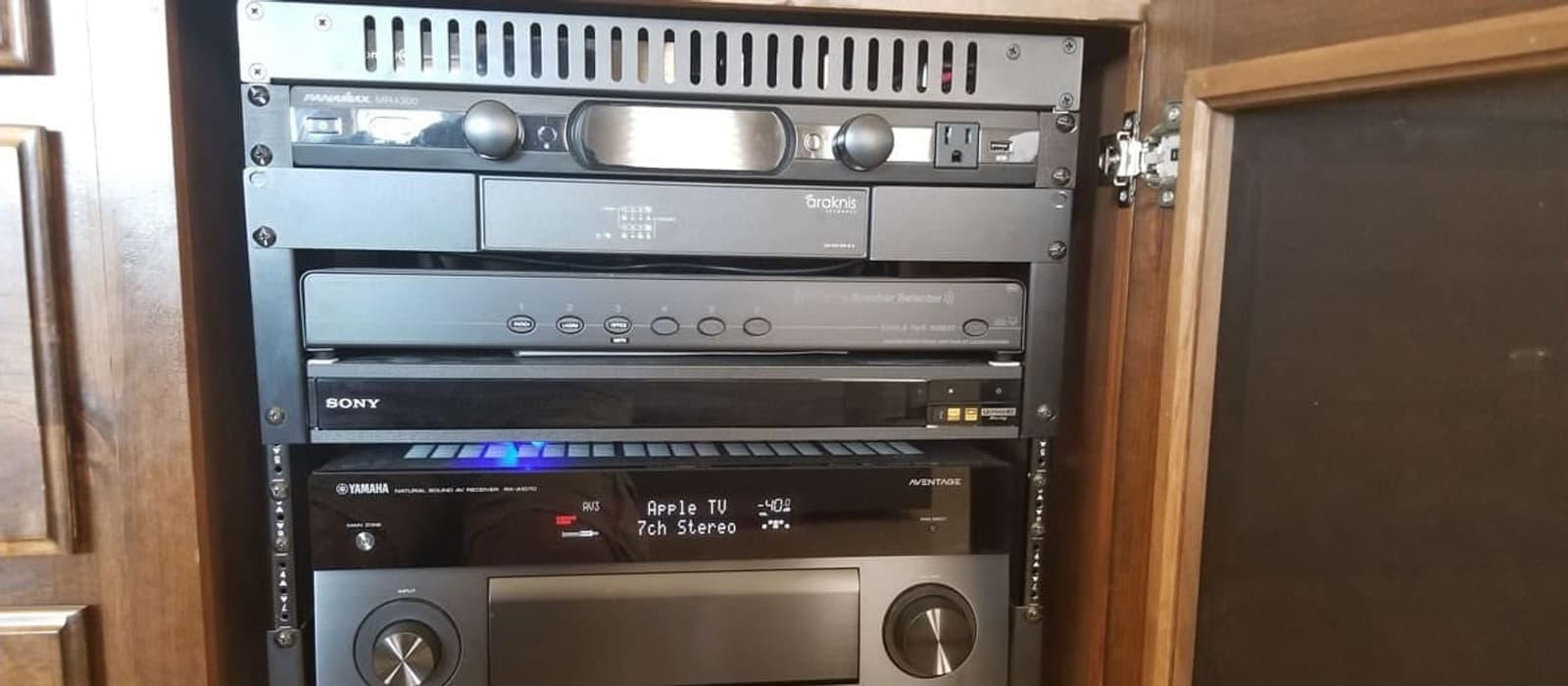
Whole-home protection handles the big hit; point-of-use handles what gets through and what arrives on signal lines. A proper rack-mounted power conditioner protects power, coax and network together — which matters, because that is where the surge you did not plan for comes in. We specify Panamax and Furman for this.
Protect the signal paths, not just the power
Coax from a roof antenna or dish, incoming internet, long outdoor speaker runs, buried landscape lighting runs, cable to a detached casita or garage: each is a potential entry path. Any of them can carry a surge past a power-only protector.
The failures we see that were avoidable
- Roof antenna coax with no protection at all. Straight path from the roof to the receiver.
- Outdoor speaker runs terminated at an amplifier with no signal-line protection. The run acts as an antenna; the amplifier pays.
- Network switch in a garage on an unprotected circuit. It takes out the switch, then everything downstream of it.
- Surge protectors installed a decade ago and never checked. They wear out. Most have an indicator; almost nobody looks at it.
- Water, not lightning. Unsealed cable penetrations letting monsoon rain track into a wall or into an outdoor enclosure.
A short pre-monsoon checklist
- Check the indicator light on every surge protector you own. If it says the protection has failed, it has, and the strip is now an expensive extension cord.
- Confirm anything on an incoming coax or network line has signal-line protection, not just power protection.
- Look at outdoor equipment enclosures for water ingress and at cable penetrations for failed sealant.
- Make sure your system is actually backed up — controller configurations and programming should not exist only on the device that just died.
- If your home has never had a service-entrance surge device fitted, that is the highest-value call you can make before June.
If something already failed
Bring us the make and model. We service systems we did not install, and after a storm the damage is frequently limited to one component in a chain rather than the whole system — a receiver's HDMI board, a network switch, a single amplifier channel. It is worth finding out before replacing everything.